
5 Myths About Dental Implants, and What Is Actually True
By Prof. Dr. S. Jimson, Oral & Maxillofacial Surgeon, Jim’s Dental Care, Chennai
Many people live with a missing tooth for years. Often it is not cost or time that holds them back, but something they heard from a friend or relative: implants hurt, they are only for young people, or the body will reject them.
In more than 25 years of oral and maxillofacial surgery, I have heard these worries almost every week. Most of them are myths. Here are the five we hear most often in clinic, and what is actually true.
Myth 1: “Implants are very painful”
Implant placement is done under local anaesthesia, the same numbing used for a filling or an extraction. Most patients feel pressure during the procedure, not pain.
Afterwards, mild soreness and some swelling for a few days is normal, and simple painkillers usually manage it. Many patients tell us it was easier than the extraction that came before it. If you feel anxious, tell us beforehand; anxiety can make any procedure feel harder than it is, and we can plan around It under sedation (sleep dentistry).
Myth 2: “I’m too old for implants”
There is rarely an upper age limit for dental implants. What matters far more is your general health and the bone in your jaw.
Factors we look at carefully include uncontrolled diabetes, heavy smoking, active gum disease and bone quality. Many patients in their sixties, seventies and beyond have implants successfully. The only firm lower limit is that the jaw must have finished growing, which is why implants are not placed in children.
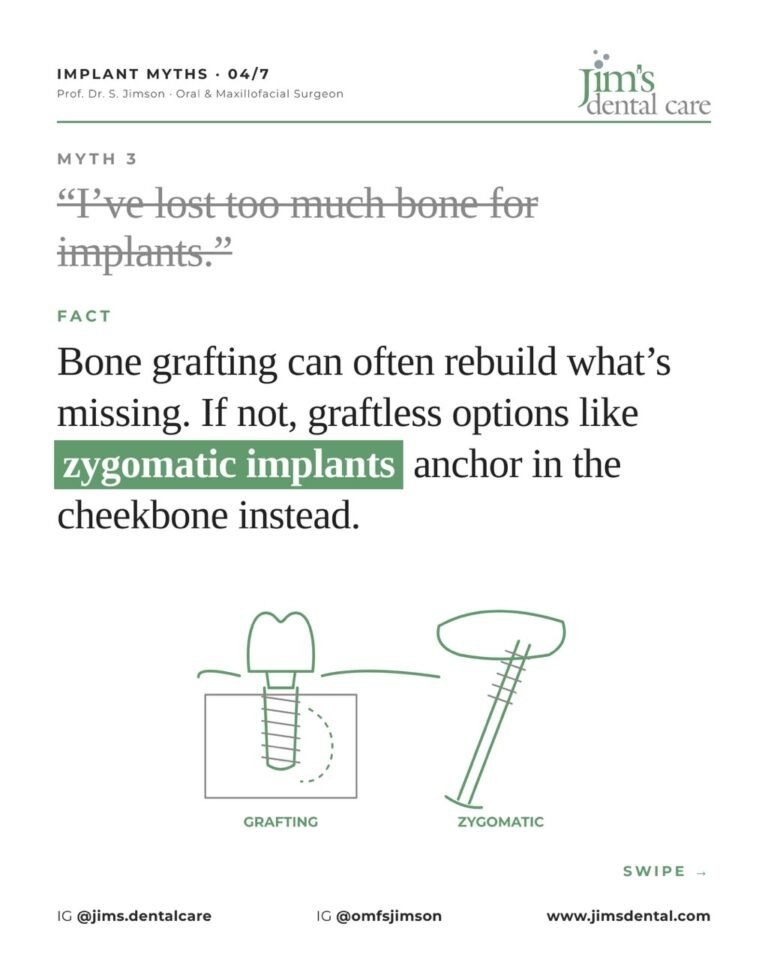
Myth 3: “I’ve lost too much bone for implants”
When a tooth is lost, the bone around it slowly shrinks. That does not automatically rule out implants.
Bone grafting can often rebuild what is missing, so that an implant can be placed securely. When grafting is not suitable, for example after severe bone loss in the upper jaw, graftless options exist. Zygomatic implants are longer implants that anchor in the cheekbone (the zygoma) instead of the thin upper jawbone.
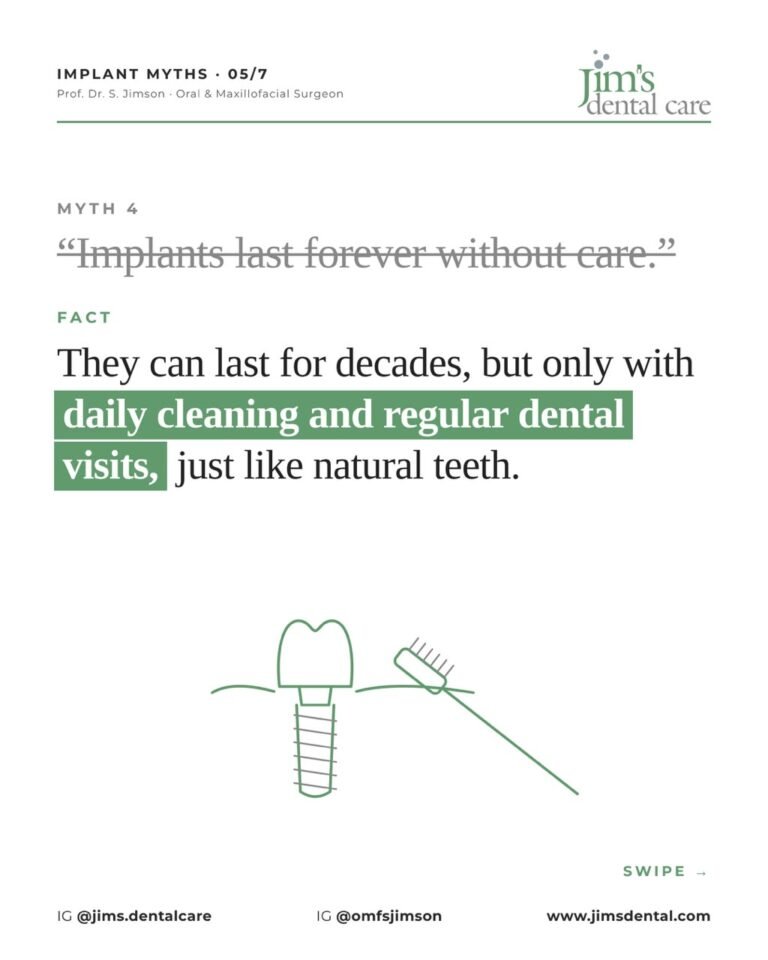
Myth 4: “Implants last forever without care”
A well-placed implant can last for decades, but only with care, just like natural teeth.
The gum around an implant can become inflamed, a condition called peri-implant mucositis. If it is ignored, it can progress to peri-implantitis, which damages the supporting bone and is the most common reason implants fail in the long term. Daily brushing and cleaning between teeth, and regular dental visits, keep this in check.
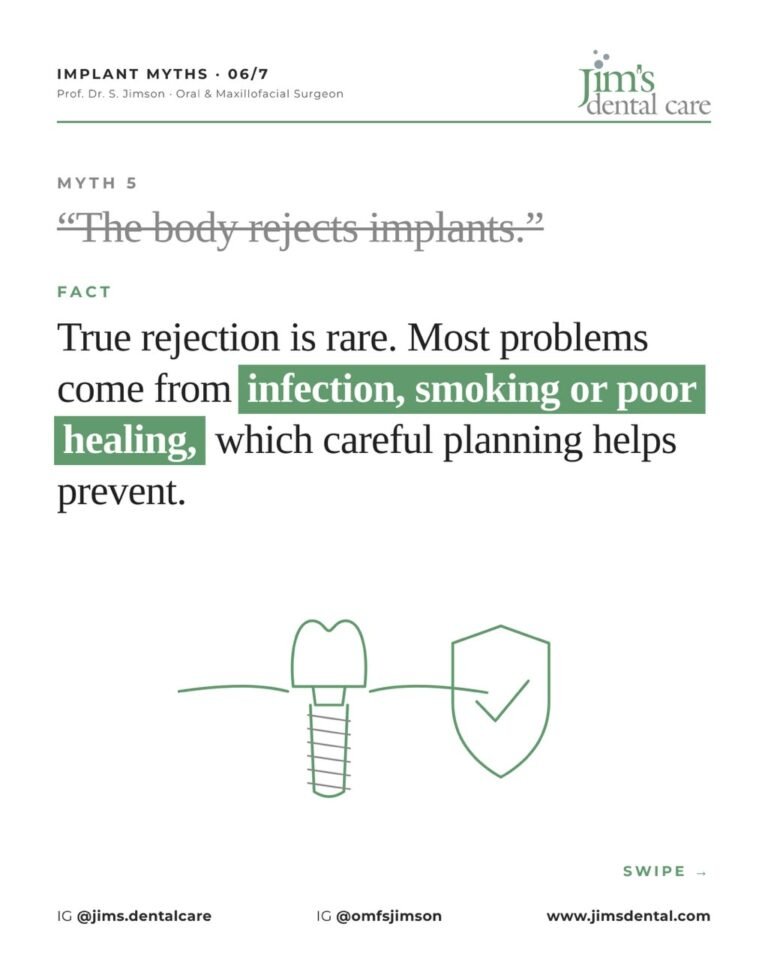
Myth 5: “The body rejects implants”
True immune rejection of a titanium implant is rare. When people say an implant was “rejected”, they usually mean it failed for another reason.
The common causes are infection, smoking, excessive biting forces (for example from grinding) and poor healing. Careful assessment and planning before treatment, and good care afterwards, reduce these risks.
Is an implant right for you?
Every mouth is different. The only way to know whether implants suit you is a proper assessment: a clinical examination, a look at your general health, and usually an X-ray or CBCT scan to check the bone.
If you are missing a tooth and have been putting off a decision because of one of these myths, come and ask. Jim’s Dental Care, Periyar Nagar, Perambur, Chennai, is open till 9 pm. You can also read about what affects the cost of dental implants in Chennai.
About the author
Prof. Dr. S. Jimson (MDS, FDS RCPS Glasgow) is an oral and maxillofacial surgeon with 31 years in dentistry, 25 of them in oral and maxillofacial surgery. He treats patients at Jim’s Dental Care, Chennai.
This article is for general education only. It is not a substitute for a consultation. Please ask your dentist about your case.

